Apparently a lot of search results that might have led to pages on this blog were being redirected by a bad widget at this blog. That widget was downloaded and installed from Google!
Apologies if you have been forcibly re-directed to something called 1 widgetserver dot com.
The widget has been removed. The browser hijacker has been eliminated.
15 February 2019


14 March 2018
A Quick Guide for Teachers Using Core English for Global Communication
I am making a PDF available for download. It is an overview and quick guide about the textbook for teachers who are planning to use the book in their EFL courses. It may also be of interest for those who are considering the textbook for classroom use.
It explains the language proficiency levels that the book has been designed for (in terms of TOEIC, CEFR, etc.). It then looks at the main task sets in each unit. Finally, it gives a message that teachers might use in their first class to help their students engage the book and English learning in class. In future blog posts here, we will be looking at sample units and then specifically at how to teach and manage each task set in the book. We will also look at alternative procedures for running the tasks in class.
Please note, this file is not the teacher's manual. The teacher's manual is available from Asahi Press.

It explains the language proficiency levels that the book has been designed for (in terms of TOEIC, CEFR, etc.). It then looks at the main task sets in each unit. Finally, it gives a message that teachers might use in their first class to help their students engage the book and English learning in class. In future blog posts here, we will be looking at sample units and then specifically at how to teach and manage each task set in the book. We will also look at alternative procedures for running the tasks in class.
Please note, this file is not the teacher's manual. The teacher's manual is available from Asahi Press.
12 March 2018
Sister Blogs of JHEO
I no longer write news pieces about the HE sector in Japan for THES or EL Gazette. My focus now is mostly on ELT in Japan. I am keeping active publishing on these blogs. I will occasionally post new links and my own articles at my other blogs that relate specifically to news about HE and ELT in Japan.
ELT in Japan (ELT-J) is my main blog.
https://eltinjapan.blogspot.jp
And the new related blog focuses on my recently published EFL
textbook, Core English for Global Communication (Asahi Press, 2018).
https://coreenglishforglobalcommunication.blogspot.jp
ELT in Japan (ELT-J) is my main blog.
https://eltinjapan.blogspot.jp
And the new related blog focuses on my recently published EFL
textbook, Core English for Global Communication (Asahi Press, 2018).
Core English for Global Communication (CEGC) is the new blog.
https://coreenglishforglobalcommunication.blogspot.jp
30 May 2015
VELC--a possible alternative for TOEIC
This too was posted to www.eltinjapan.com, about an English proficiency test normed specifically to Japanese university students.
VELC--a possible alternative for TOEIC
VELC--a possible alternative for TOEIC
VELC has been developed as an English proficiency test for Japanese university students (normed to a large population of such EFL learners), unlike the TOEIC. I have excerpted the abstract from the article's online PDF. VELC stands for 'Visualizing English Language Competency'. It takes about 70 minutes to administer a version of the test to a group, while the TOEIC takes about 3 hours.
http://www.velctest.org/contact/VelcTest-for-TestingCompetency.pdf
Abstract
The authors have developed a new competency test to make visible the English-language skills of Japanese university students as much as possible. The test divides the two sections of listening and reading into three parts each, measuring listening ,(vocabulary (L1), connected speech deciphering (L2), and listening comprehension (L3) along with reading vocabulary (R1 sentence structure awareness (R2), and reading comprehension (R3). Equating data from trial testing of approximately 5000 Japanese university students, using a Rasch model, makes it possible to compare scores on the same scale no matter which of multiple forms the test takers used. The test’s coefficient of reliability is higher than 0.95, and its multiple correlation coefficient to TOEIC scores is 0.82. Feedback on results is provided through a Web-based e-Portfolio that can be described as a record of an individual’s English-language ability. Students also can use this test to ascertain changes in their own English-language abilities by taking the test periodically. As a result, it can be expected to see a variety of uses that have not been possible with previous one-time testing.
http://www.velctest.org/contact/VelcTest-for-TestingCompetency.pdf
Abstract
The authors have developed a new competency test to make visible the English-language skills of Japanese university students as much as possible. The test divides the two sections of listening and reading into three parts each, measuring listening ,(vocabulary (L1), connected speech deciphering (L2), and listening comprehension (L3) along with reading vocabulary (R1 sentence structure awareness (R2), and reading comprehension (R3). Equating data from trial testing of approximately 5000 Japanese university students, using a Rasch model, makes it possible to compare scores on the same scale no matter which of multiple forms the test takers used. The test’s coefficient of reliability is higher than 0.95, and its multiple correlation coefficient to TOEIC scores is 0.82. Feedback on results is provided through a Web-based e-Portfolio that can be described as a record of an individual’s English-language ability. Students also can use this test to ascertain changes in their own English-language abilities by taking the test periodically. As a result, it can be expected to see a variety of uses that have not been possible with previous one-time testing.
TOEIC is not a very good test for university students in Japan
Note: this has also been published at the sister site, www.eltinjapan.com. However, because the issue is how TOEIC is a mismatch for university students, it is being published here too.
TOEIC is not a very good test for university students in Japan
First, there are a lot of questions about how both TOEIC and ETS are run. But let's ignore those for now. The real issue is whether or not TOEIC proves a very good match for university students. Is it a good English proficiency test? Problems with TOEIC include:
1. It's too long. It's easy to get behind the audio during the listening test, and it's hard to concentrate and keep on pace to finish the reading test. About 3 hours are required to take the test, much of it concentrating intensively on the test problems.
2. It lacks practical communicative tasks--especially ones that require any real production, such as speaking or writing.
3. Its main focus is business and business traveler English, so it is schematically outside of the experiences and immediate needs and interests of university students in Japan.
4. It's too much an EFL literacy test: half the test is 'reading', and the other half, the 'listening' parts, require reading as well (e.g., Parts 3 and 4).
5. It's a norm-referenced test that basically puts inexperienced 18-22 year olds in direct competition with older, more experienced company and government workers for their 'level of attainment' in the tested group.
6. It's hard to analyze students' scores in order to come up with a better study plan for them. Many Japanese students think that their reading skills far exceed their listening ones. But at the lower proficiency levels (the bulk of the students here), the more typical pattern is for them to do much better on the listening sections of the test than the reading ones. However, it is difficult to devise a better study plan for them. It seems, though, for example, lower level learners might more quickly boost their scores by concentrating on the parts that they can master more quickly--which are probably Listening Part 3 and Reading Part 5.
7. Studying old tests and pseudo-TOEIC questions might help produce test-wiseness in the students, but these prove time and again to be horrible ways to help students learn English. What is needed is better-thought-out exercises and activities that help students learn, revise, and review the typical English that they need to take the TOEIC. The main thing taking practice tests does is reinforce failure and under-achievement.
Perhaps these issues also hold in places like China and South Korea too, so it is little wonder then that governments and institutions in Asia are seeking to develop language proficiency tests that might fit national cultures better. It is also understandable why some might want to develop a better language proficiency test for young adults, such as university students typically aged 18-22.
01 April 2015
To University of Fukui: Stop starving the cats who live on campus. 福井大学に対する嘆願書:キャンパス内の猫を飢えさせるのは止めてください!
To University of Fukui: Stop starving the cats who live on campus. 福井大学に対する嘆願書:キャンパス内の猫を飢えさせるのは止めてください!
Why this is important
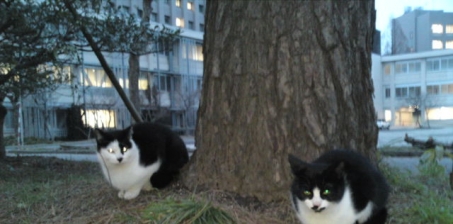
Starving the cats is not a humane solution to the issue of cats on campus. It is not even a solution. The solution is to allow and cooperate with the volunteers who want to finish spaying and neutering the cats. Then the cats can be properly fed and cared for. The ones who are suitable can be adopted. The others will live out their lives and actually keep new cats away from campus.キャンパス内の猫を飢えさせるのは止めてください!
私は日本の福井市の福井大学の准教授です。福井大学の文京 キャンパスでは、猫たちが小さな集団を作って暮らしています。現在キャンパスには12匹の猫が暮らしていると推測しています。ほとんどの猫はキャンパス内 で生まれましたが、迷子になった猫と捨てられた猫もこの集団に加わっています。
3年前より、工学部の一部の人がキャンパスの一部(南西部の隅)で猫の家族に餌を与えていました。しかし、この猫たちは不妊手術を受けていませんでした。そのため、猫の数は10匹まであっという間に増えました。
過去6か月にわたり、私はキャンパス内およびキャンパスのすぐ南東の近くで暮らすすべての猫に不妊手術を受けさせてきました。不妊手術を受けさせる必要のある猫はまだ3匹残っています。
しかしながら、福井大学は私の活動に反対しています。大学側は私に餌を与えること、不妊手術を受けさせることなど、すべてを止めるよう命令しています。
この問題に対し大学側が提案した解決策は猫を餓死させることです。
こ れは解決法とは言えません。本当の解決法は、すべての猫に不妊手術を受けさせること、猫を迎えてくれる家庭を見つけること、キャンパス内の猫の数を健全な 数に保つことです。キャンパスに残った猫たちが新たな猫がキャンパスに来ることを防いでくれます。多くの学生および大学職員は猫が好きであり、キャンパス で猫を見かけるのを楽しみにしています。大学当局が承認してくだされば、猫の世話をボランティアで引き受けてくれる人も出てくるでしょう。
猫を飢え死にさせることは解決法ではありません。
キャンパス内の猫が生きていけるよう、福井大学にお願いしてください。この嘆願書に署名をお願いします。そしてこの件を他の方と共有してください。
Additional background explanation:
I am an associate professor at the University of Fukui, Fukui City, Japan. The Bunkyo Campus of the university has a small colony of cats on it. I estimate that there are now 12 cats living on campus. Most were born here, but strays and abandoned cats have added to the population.
From three years ago, some people at the College of Engineering were feeding a family of cats in that part of the campus (the southwest corner). But they were not doing spaying or neutering. So the population quickly grew to over 10 cats.
For the past 6 months, I have been spaying and neutering all the cats on campus and also at a near-by colony just southeast of campus. There are still 3 cats that need to be spayed or neutered.
However, the university opposes my activities. They are ordering me to stop feeding, spaying, neutering, everything.
Their proposed solution to the issue is that the cats should starve.
This is not a solution. The solution is to complete the spaying and neutering, find homes for those that are adoptable, and maintain a healthy population on campus. The cats that remain will keep new cats from coming onto campus. Many students and members of the faculty like the cats and enjoy seeing them on campus. Some would volunteer to help take care of the cats if the university administration would approve.
Sign the petition at the link below:
https://secure.avaaz.org/en/petition/University_of_Fukui_Fukui_Japan_The_University_of_Fukui_must_stop_starving_the_cats_who_live_on_campus/edit/
15 March 2015
Fukui professor arrested over female graduate student’s murder
Japan HEO blog wouldn't normally post this here, except we are at the University of Fukui, and also in the same faculty (College of Education and Regional Studies).
http://www.japantimes.co.jp/news/2015/03/14/national/crime-legal/fukui-professor-arrested-over-female-graduate-students-murder/#.VQTlio6NDhU
http://www.japantimes.co.jp/news/2015/03/14/national/crime-legal/fukui-professor-arrested-over-female-graduate-students-murder/#.VQTlio6NDhU
http://www.japantimes.co.jp/news/2015/03/14/national/crime-legal/fukui-professor-arrested-over-female-graduate-students-murder/#.VQTlio6NDhU
Fukui professor arrested over female graduate student’s murder
Kyodo
FUKUI – An associate
professor at a national university in Fukui Prefecture was arrested
Saturday on suspicion of killing a female graduate student under his
tutelage, police said.http://www.japantimes.co.jp/news/2015/03/14/national/crime-legal/fukui-professor-arrested-over-female-graduate-students-murder/#.VQTlio6NDhU
30 August 2013
A summary of what is going on at Fukushima as of 30 August 2013.
The biggest 'fallout' for the higher ed sector has been the collapse in the numbers of students applying for nuclear-energy-related programs at universities (e.g., the one at University of Fukui, where I work--and University of Fukui and the prefecture are in deep with the nuclear power industry for money while the prefecture hosts more reactors than any other in Japan, 13 of the 50 in the country). The two reactors now operating (the others are still shut down) are in Oi, in southern Fukui Prefecture.
--------------------------------------------------------------
Fukushima, Japan update Charles Jannuzi in Fukui, Japan
A lot of alarming reports and comments are appearing in the western media about the situation at the Fukushima Dai-ichi nuclear reactors in NE Japan. They largely echo what has been appearing in the media here in Japan.
Are things getting so out of control that they will affect the health and well-being of not only the Japanese but other Pacific Rim nations, including the west coast of the United States? Is the escaping contamination from Fukushima going to turn off sushi eaters in the US? (Elevated levels of cesium have been reported in tuna as far away as California).
Let's try to untangle the contamination and leak issues that have been in the news a lot recently. What are the sources of the reported leaks?
It seems that the issue is actually THREE issues:
1. They have been storing a lot of the water that they pump into the stricken reactors to cool both the piles of depleted fuel rods (which take years to cool down properly) and the melted down cores. The excess water from these cooling operations they have then been attempting to filter in order to decontaminate. What they can not decontaminate and recycle for cooling they have been storing in hundreds of makeshift tanks above ground. It appears that some of the tanks have not held up well and have been leaking.
2. Four of the six reactor buildings at the site are heavily damaged from hydrogen explosions and from the melting down of the cores (which may have punched holes in the bottom of the containment). This has made the reactor buildings leaky. So any water pumped in to cool rod piles and core material may leak out into the ground.
3. It's not really clear from reports just what are the states and locations of the cores of three of the reactors. The three that have melted down might have escaped the final bottom layers of containment and lodged in the ground beneath the reactor buildings. If so, groundwater working its way through from the hills above the site could also be coming in contact with radioactive materials from the melted down cores and contributing to the contaminated water problems. Also, the reactors that exploded expelled core material into the air, which may have come down around the reactor site, and this material too could be working its way into the ground water or at least the water that flows out of the site into the sea.
On the positive side, there is right now little danger of radioactive materials escaping into the air and moving on the wind. It's mostly an issue of what is in the water at the site.
There is, however, another dangerous problem. This is the large, elevated pool filled with fuel rods that had been taken out of Reactor 4 before the disasters. This pool is in danger of collapsing because the support structures around it are weakened from the explosion while the reactor building itself is subsiding.
If the storage pool were to collapse and there were a loss of coolant, the rods could overheat and cause radioactive leaks into the air again. Since it is a very large amount of spent fuel, such an incident could, in theory, threaten cities downwind of the site, including the Kanto/Tokyo metropolitan area of 35 million people to the south.
Should Americans living on the west coast be worried about the leaking radioactive materials flowing around the Pacific? So far, the ocean has dispersed and diluted most of the contamination. However, contaminants such as cesium and strontium may not just disperse the way the ocean currents take them. If they end up in food chains (from plankton to small fish, from small fish to larger fish, etc.), they could accumulate and show up in the Pacific fish and seafood that Americans eat.
Cesium acts a lot like potassium, so eating potassium-rich foods (such as avocadoes and bananas) can help displace cesium in the human body. Similarly, strontium acts a lot like calcium, so a diet rich in calcium can help displace strontium.The Fukushima Daiichi reactors used MOX fuel, which includes plutonium. Some plutonium has been detected well away from the reactors, which indicates it was expelled when the reactor buildings exploded and burned.
The biggest challenge now facing Tepco and the government of Japan is not really the immediate clean up of the Fukushima site. Rather the challenge is to get the site into stable enough shape in order for real clean up to proceed, with clean up taking up to 50 years or more.
For that to happen, they will have to somehow stop or divert the groundwater that flows under the site, since this groundwater could be coming into contact with core material in the ground and then flowing into the ocean.
There have been calls from overseas for Japan to allow for an international effort to help at Fukushima, but Japan is a country that prides itself on self-sufficiency in such matters, and teams from overseas would be expensive to house, feed, supply and provide interpreters for, while they might not really have the expertise that the disasters require.
Part of the problem is that former Soviet countries have the experience with a severe disaster (that is, Russia and Ukraine with Chernobyl), but the reactors in Japan are an American design--the GE Mark I boiling water reactors (BWR), also in heavy use in the US and other parts of the world. Russia and Ukraine do have expertise in the use of purified Prussian Blue to lower the levels of radioactive cesium in humans and animals that may have breathed, eaten or drunk it. But relations between Japan and Russia have deteriorated recently. The US military is said to be sitting on a large stockpile of Prussian Blue, but there have been no reports of them offering to supply it to Japan.
Meanwhile, government policies under PM Abe have brought some relief to the ailing economy (Abenomics). But for example, the intentionally cheaper yen that has helped Japan's famous exporters (like Toyota, Nissan, Canon and Sony) has also made imported oil and gas much more expensive. Before the disasters, nuclear energy had provided over 30% of Japan's electricity needs. Japan is a country of 127 million people that must import about 85% of its total energy needs.
There is now a lot of pressure from the power companies to get the government to allow them to re-start most of Japan's 50 reactors while continuing the construction of new ones. During the recent hot summer there were reported energy shortages but no major blackouts. Power plants burning oil, gas and coal have taken up the slack. Public buildings have kept their thermostats set at a rather warm 85 F to conserve energy, which at least has led to a boom in Cool Biz clothing for office workers.
However, 80% of the public oppose any re-start of the reactors. Despite this opposition, Oi 3 and 4 here in Fukui Prefecture have been in operation since the summer of 2012, providing electricity to the Osaka/Kansai metropolis area.
Unfortunately, it seems the Fukushima nuclear disasters and energy troubles are going to remain in the news for years to come.
--------------------------------------------------------------
Fukushima, Japan update Charles Jannuzi in Fukui, Japan
A lot of alarming reports and comments are appearing in the western media about the situation at the Fukushima Dai-ichi nuclear reactors in NE Japan. They largely echo what has been appearing in the media here in Japan.
Are things getting so out of control that they will affect the health and well-being of not only the Japanese but other Pacific Rim nations, including the west coast of the United States? Is the escaping contamination from Fukushima going to turn off sushi eaters in the US? (Elevated levels of cesium have been reported in tuna as far away as California).
Let's try to untangle the contamination and leak issues that have been in the news a lot recently. What are the sources of the reported leaks?
It seems that the issue is actually THREE issues:
1. They have been storing a lot of the water that they pump into the stricken reactors to cool both the piles of depleted fuel rods (which take years to cool down properly) and the melted down cores. The excess water from these cooling operations they have then been attempting to filter in order to decontaminate. What they can not decontaminate and recycle for cooling they have been storing in hundreds of makeshift tanks above ground. It appears that some of the tanks have not held up well and have been leaking.
2. Four of the six reactor buildings at the site are heavily damaged from hydrogen explosions and from the melting down of the cores (which may have punched holes in the bottom of the containment). This has made the reactor buildings leaky. So any water pumped in to cool rod piles and core material may leak out into the ground.
3. It's not really clear from reports just what are the states and locations of the cores of three of the reactors. The three that have melted down might have escaped the final bottom layers of containment and lodged in the ground beneath the reactor buildings. If so, groundwater working its way through from the hills above the site could also be coming in contact with radioactive materials from the melted down cores and contributing to the contaminated water problems. Also, the reactors that exploded expelled core material into the air, which may have come down around the reactor site, and this material too could be working its way into the ground water or at least the water that flows out of the site into the sea.
On the positive side, there is right now little danger of radioactive materials escaping into the air and moving on the wind. It's mostly an issue of what is in the water at the site.
There is, however, another dangerous problem. This is the large, elevated pool filled with fuel rods that had been taken out of Reactor 4 before the disasters. This pool is in danger of collapsing because the support structures around it are weakened from the explosion while the reactor building itself is subsiding.
If the storage pool were to collapse and there were a loss of coolant, the rods could overheat and cause radioactive leaks into the air again. Since it is a very large amount of spent fuel, such an incident could, in theory, threaten cities downwind of the site, including the Kanto/Tokyo metropolitan area of 35 million people to the south.
Should Americans living on the west coast be worried about the leaking radioactive materials flowing around the Pacific? So far, the ocean has dispersed and diluted most of the contamination. However, contaminants such as cesium and strontium may not just disperse the way the ocean currents take them. If they end up in food chains (from plankton to small fish, from small fish to larger fish, etc.), they could accumulate and show up in the Pacific fish and seafood that Americans eat.
Cesium acts a lot like potassium, so eating potassium-rich foods (such as avocadoes and bananas) can help displace cesium in the human body. Similarly, strontium acts a lot like calcium, so a diet rich in calcium can help displace strontium.The Fukushima Daiichi reactors used MOX fuel, which includes plutonium. Some plutonium has been detected well away from the reactors, which indicates it was expelled when the reactor buildings exploded and burned.
The biggest challenge now facing Tepco and the government of Japan is not really the immediate clean up of the Fukushima site. Rather the challenge is to get the site into stable enough shape in order for real clean up to proceed, with clean up taking up to 50 years or more.
For that to happen, they will have to somehow stop or divert the groundwater that flows under the site, since this groundwater could be coming into contact with core material in the ground and then flowing into the ocean.
There have been calls from overseas for Japan to allow for an international effort to help at Fukushima, but Japan is a country that prides itself on self-sufficiency in such matters, and teams from overseas would be expensive to house, feed, supply and provide interpreters for, while they might not really have the expertise that the disasters require.
Part of the problem is that former Soviet countries have the experience with a severe disaster (that is, Russia and Ukraine with Chernobyl), but the reactors in Japan are an American design--the GE Mark I boiling water reactors (BWR), also in heavy use in the US and other parts of the world. Russia and Ukraine do have expertise in the use of purified Prussian Blue to lower the levels of radioactive cesium in humans and animals that may have breathed, eaten or drunk it. But relations between Japan and Russia have deteriorated recently. The US military is said to be sitting on a large stockpile of Prussian Blue, but there have been no reports of them offering to supply it to Japan.
Meanwhile, government policies under PM Abe have brought some relief to the ailing economy (Abenomics). But for example, the intentionally cheaper yen that has helped Japan's famous exporters (like Toyota, Nissan, Canon and Sony) has also made imported oil and gas much more expensive. Before the disasters, nuclear energy had provided over 30% of Japan's electricity needs. Japan is a country of 127 million people that must import about 85% of its total energy needs.
There is now a lot of pressure from the power companies to get the government to allow them to re-start most of Japan's 50 reactors while continuing the construction of new ones. During the recent hot summer there were reported energy shortages but no major blackouts. Power plants burning oil, gas and coal have taken up the slack. Public buildings have kept their thermostats set at a rather warm 85 F to conserve energy, which at least has led to a boom in Cool Biz clothing for office workers.
However, 80% of the public oppose any re-start of the reactors. Despite this opposition, Oi 3 and 4 here in Fukui Prefecture have been in operation since the summer of 2012, providing electricity to the Osaka/Kansai metropolis area.
Unfortunately, it seems the Fukushima nuclear disasters and energy troubles are going to remain in the news for years to come.
04 December 2012
Coming soon: Our first e-book
http://eltinjapan.blogspot.jp/2012/12/coming-soon-our-first-e-book.html
Right now we are at work on an e-book for English teachers in Japan.
21 October 2012
New Issue of ELT in Japan (Issue 5, OCTOBER 2012)
ELT in Japan Issue #5 (October 2012)
ELT in Japan Issue #5 (October 2012)
ELT in Japan (Issue 5, OCTOBER 2012)
In this issue:
1. Pronunciation in the Japanese Elementary EFL Classroom: A Few Perspectives
by Matt Hauca.........................................................pp. 1-5
2. Conceptualizing Phonological Awareness for EFL Learning and Literacy
by CharlesJannuzi.................................................pp. 6-10
View a preview page.
http://preview.tinyurl.com/9e7zt35
[Open in new window]
View the entire publication at Google Documents or download the entire issue in .pdf (Adobe Acrobat Reader program required).
06 April 2012
Japan Times: Japan's top university aims for autumn school year start within 5 years
The hopes are that a fall start to the school year (instead of the April start that is the standard in Japan) will encourage Japanese students to study abroad more as well as draw more foreign students to Todai. However, such a move could put the university out of synch with the rest of the country. Although Todai may have little to worry about, universities and colleges which do not have huge numbers of surplus applicants may be reluctant to undertake such a major change.
http://www.japantimes.co.jp/text/nn20120121a3.html
Excerpt:
As of last May, only 53 undergraduates at the University of Tokyo, 0.4 percent of the student body, were studying overseas, the report says.
Foreign students in the undergraduate program at the school, known locally as Todai, currently account for only 1.9 percent of the total, compared with 10 percent at Harvard University and 6 percent at Seoul National University, it says.
"I don't think the change will sharply increase the number of foreign students nor Japanese students going abroad to study. There are still many other factors," Hamada said. "But I believe by establishing this fall enrollment system, the process toward internationalization will move forward."
See also:
Is Japan's enrollment season really a problem?
http://www.japantimes.co.jp/text/fl20120303cz.html
12 universities to launch forum on fall enrollment
http://www.japantimes.co.jp/text/nn20120330a8.html
http://www.japantimes.co.jp/text/nn20120121a3.html
Excerpt:
As of last May, only 53 undergraduates at the University of Tokyo, 0.4 percent of the student body, were studying overseas, the report says.
Foreign students in the undergraduate program at the school, known locally as Todai, currently account for only 1.9 percent of the total, compared with 10 percent at Harvard University and 6 percent at Seoul National University, it says.
"I don't think the change will sharply increase the number of foreign students nor Japanese students going abroad to study. There are still many other factors," Hamada said. "But I believe by establishing this fall enrollment system, the process toward internationalization will move forward."
See also:
Is Japan's enrollment season really a problem?
http://www.japantimes.co.jp/text/fl20120303cz.html
12 universities to launch forum on fall enrollment
http://www.japantimes.co.jp/text/nn20120330a8.html
29 February 2012
Japan's top university--Univ. of Tokyo--tries to recruit students from India
Chinese nationals dominate the 140,000 international tertiary students in Japan now.
http://www.japantimes.co.jp/text/nn20120228a7.html
excerpt:
The University of Tokyo opened an office in the high-tech Indian city of Bangalore on Monday to recruit local students. While about 1,000 Chinese and about 600 South Korean students were studying at the university as of May last year, there were only 35 Indians....Indians account for fewer than 600 of the 140,000 foreign students enrolled at Japanese universities.
http://www.japantimes.co.jp/text/nn20120228a7.html
http://www.japantimes.co.jp/text/nn20120228a7.html
excerpt:
The University of Tokyo opened an office in the high-tech Indian city of Bangalore on Monday to recruit local students. While about 1,000 Chinese and about 600 South Korean students were studying at the university as of May last year, there were only 35 Indians....Indians account for fewer than 600 of the 140,000 foreign students enrolled at Japanese universities.
http://www.japantimes.co.jp/text/nn20120228a7.html
Japan public civil servants--including university faculty--hit with 8% pay cuts
But university faculty have never fully been given collective bargaining rights or the right to strike. See:
http://www.asiaone.com/News/AsiaOne%2BNews/Asia/Story/A1Story20120219-328806.html
excerpt:
The policy chiefs of the ruling Democratic Party of Japan and the opposition Liberal Democratic Party and New Komeito have agreed to cut the salaries of national government employees by an average of 7.8 per cent for two years beginning in fiscal 2012. The cuts will include a retroactive 0.23 per cent cut extending back to April 2011, in line with a figure proposed by the National Personnel Authority. Funds saved through the salary cuts--totaling about 588 billion yen--will be used for the reconstruction of areas devastated by the Great East Japan Earthquake.
http://www.asiaone.com/News/AsiaOne%2BNews/Asia/Story/A1Story20120219-328806.html
http://www.asiaone.com/News/AsiaOne%2BNews/Asia/Story/A1Story20120219-328806.html
excerpt:
The policy chiefs of the ruling Democratic Party of Japan and the opposition Liberal Democratic Party and New Komeito have agreed to cut the salaries of national government employees by an average of 7.8 per cent for two years beginning in fiscal 2012. The cuts will include a retroactive 0.23 per cent cut extending back to April 2011, in line with a figure proposed by the National Personnel Authority. Funds saved through the salary cuts--totaling about 588 billion yen--will be used for the reconstruction of areas devastated by the Great East Japan Earthquake.
http://www.asiaone.com/News/AsiaOne%2BNews/Asia/Story/A1Story20120219-328806.html
20 February 2012
Japan Times: Japan's Universities Floundering at Reform and Revitalization
http://www.japantimes.co.jp/text/eo20120123ts.html
excerpt:
On Nov. 21, 2011, the Government Revitalization Unit (GRU) took up the issue of reform of Japan's university system. Five themes were presented by GRU members: [quality, greater access, falling academic achievement and standards, clear vision for the future, academic vs. real world gap in learning].
http://www.japantimes.co.jp/text/eo20120123ts.html
excerpt:
On Nov. 21, 2011, the Government Revitalization Unit (GRU) took up the issue of reform of Japan's university system. Five themes were presented by GRU members: [quality, greater access, falling academic achievement and standards, clear vision for the future, academic vs. real world gap in learning].
http://www.japantimes.co.jp/text/eo20120123ts.html
Japan Times: Top University in Japan Plans to Shift Undergraduate Enrollment to Fall
http://www.japantimes.co.jp/text/nn20120218f1.html
excerpt:
The University of Tokyo's move [to shift undergraduate enrollment from spring to autumn] would have a far broader and deeper effect on Japanese society and force authorities to amend long-established practices, notably the season when companies recruit graduates and the timing of various national examinations, such as those medical students take in February to qualify for a medical license.
http://www.japantimes.co.jp/text/nn20120218f1.html
excerpt:
The University of Tokyo's move [to shift undergraduate enrollment from spring to autumn] would have a far broader and deeper effect on Japanese society and force authorities to amend long-established practices, notably the season when companies recruit graduates and the timing of various national examinations, such as those medical students take in February to qualify for a medical license.
http://www.japantimes.co.jp/text/nn20120218f1.html
09 October 2011
New issue (#4) of 'ELT in Japan'
ELT in Japan started here at Japan Higher Education Outlook as special features about teaching EFL in Japan. It is now a sister blog and online publication. The latest issue is here:
http://eltinjapan.blogspot.com/2011/10/elt-in-japan-issue-4-october-2011.html
It is also viewable as a public google document and can be downloaded as a PDF from this location:
https://docs.google.com/viewer?a=v&pid=explorer&chrome=true&srcid=0B8LogtWAF3y8NGIwNGNjNjQtOGM0Zi00ZTNmLWIxZjgtZTk3MzJjYTQzNmYz&hl=en_GB
http://eltinjapan.blogspot.com/2011/10/elt-in-japan-issue-4-october-2011.html
It is also viewable as a public google document and can be downloaded as a PDF from this location:
https://docs.google.com/viewer?a=v&pid=explorer&chrome=true&srcid=0B8LogtWAF3y8NGIwNGNjNjQtOGM0Zi00ZTNmLWIxZjgtZTk3MzJjYTQzNmYz&hl=en_GB
27 August 2011
Accreditation of HE in Japan: English-language resources and links
I read through the English-language pages of the accrediting organizations' websites. Japanese language content tends to be more extensive and updated more frequently, but I'm assuming readers of JPN HEO blog prefer English-language resources. There are four general accrediting bodies overseeing institutions undergoing accreditation. All institutions were required to do this within 7 years from 2004 until 2011. I have also included information about the Japan Accreditation Board for Engineering Education (JABEE) and its overseas network because of the impact this sort of specialty accreditation is having on science and technology departments in Japan.
I. National Institution for Academic Degrees and University Evaluation (NIAD-UE)
Types of Evaluation Systems
Certified Evaluation and Accreditation
National University Corporation Evaluation
Information Package
Glossary of Quality Assurance in Japanese Higher Education
Overview of Quality Assurance System in Higher Education
II. Japan University Accreditation Association (JUAA)
Accreditation through JUAA
Accreditation of universities through JUAA
III. Japan Institution for Higher Education Evaluation (JIHEE)
Overview
Evaluation system
University evaluation standards
IV. Japan Association for College Accreditation (JACA)
NO LINKS FOUND SO FAR
V. Japan Accreditation Board for Engineering Education (JABEE)
JABEE Overview
Accredited programs (PDF)
Accreditation process
VI. Network Of Accreditation Bodies For Engineering Education In Asia (NABEEA)
Overview
I. National Institution for Academic Degrees and University Evaluation (NIAD-UE)
Types of Evaluation Systems
Certified Evaluation and Accreditation
National University Corporation Evaluation
Information Package
Glossary of Quality Assurance in Japanese Higher Education
Overview of Quality Assurance System in Higher Education
II. Japan University Accreditation Association (JUAA)
Accreditation through JUAA
Accreditation of universities through JUAA
III. Japan Institution for Higher Education Evaluation (JIHEE)
Overview
Evaluation system
University evaluation standards
IV. Japan Association for College Accreditation (JACA)
NO LINKS FOUND SO FAR
V. Japan Accreditation Board for Engineering Education (JABEE)
JABEE Overview
Accredited programs (PDF)
Accreditation process
VI. Network Of Accreditation Bodies For Engineering Education In Asia (NABEEA)
Overview
26 August 2011
University accreditation in Japan: Problems and possibilities for reforming EFL education
This article by Bern Mulvey updates the situation on accreditation in Japan's HE system. What is needed now, perhaps, is more analysis as to what the accreditation actually does and how to improve it so that it can lead to improvement in HE here.
Once you are at the page you will see an abstract in English and Japanese. Below that 'click' or 'right click' the link and download the PDF. You will need a program like Adobe Acrobat Reader to read the PDF.
http://jalt-publications.org/tlt/articles/153-feature-article-university-accreditation-japan-problems-and-possibilities-reforming
University accreditation in Japan: Problems and possibilities for reforming EFL education
by Prof. Bern Mulvey, Iwate University
Once you are at the page you will see an abstract in English and Japanese. Below that 'click' or 'right click' the link and download the PDF. You will need a program like Adobe Acrobat Reader to read the PDF.
http://jalt-publications.org/tlt/articles/153-feature-article-university-accreditation-japan-problems-and-possibilities-reforming
University accreditation in Japan: Problems and possibilities for reforming EFL education
by Prof. Bern Mulvey, Iwate University
Reply to Taikibansei on the reply to "FACTOID #2: Are universities and colleges in Japan accredited? "
Note: the original discussion (now also posted at this blog) is at the url http://www.debito.org/?p=5503 . True to form, David Aldwinkle refuses to publish my rebuttal of Taikibansei's response to a JPN HEO article on accreditation in Japan. So it is being published here. You are a classy guy David, but so selective in your sense of fairness.
Response to Taikibansei:
1. Thank you for the attempt at corrections and clarifications. I have to point out however that this article was written in 2006 and wasn't published until early 2008. One reason why I created the blog was to get this material out there for people to read and comment on. I'm sorry it took you until 2010 to find it, only after I cross-posted it to Debito.org's site.
2. Next, you commented (your comments in italics):
Actually, the “pilot” period (including especially the jiko hyouka and evaluations by JUAA) started and finished before 2004. From 2004, everything has been “official.”
Actually I think accreditation had long been official--it just didn't mean anything to most people in Japan. I referred to that first three year period as a 'pilot program' because when I was compiling this information, I realized that there was no way they were ever going to accredit that many institutions if the initial plans were followed. So I viewed this first phase as a a pilot program because, if successful and practical, it would lead to a wider spread national breakout of the process. I didn't think of the self-evaluations as a pilot because I was unclear on how they actually piloted accreditation. As it turns out, that view might have been erroneous because self-evaluation, as I understand it, plays a huge role in accreditation here.
As for which accrediting agency does which type of institution, I don't think I specified in my article. Readers were free, however, to visit the sites of the organizations I listed to find out. During the initial period there was some confusion, and some people had asserted that National and Public University Corporations (NUCs, PUCs) might have freedom to choose if there was a backlog as to how everyone got accredited during the first phases. One reason why some agencies would move across institutional type would simply be that they are better suited for certain types of programs.
3. Continuing your comments (my material in quotes, to which you are referring, yours in italics):
“Still, until the outcomes of the first external review process become clear in the next several years and until all institutions can join the accreditation process, the national government is the single source of ‘legitimacy’ for universities and colleges.”
This doesn’t make sense at all. As alluded to above, private universities have been able to “join the accreditation process” from the beginning, and there was never any attempt to exclude anybody. JIHEE’s initial (2004-2006) seminars explaining the process were each attended by 300+ private universities, and it was made very clear then that they (JIHEE) were “ready” to start with the inspections immediately (however, see my comment in the next paragraph). Moreover, private and public universities have been being evaluated in relatively equal numbers each year. Heck, by the end of 2007 (i.e., before your blog entry to the contrary), all the major tertiary institutions in your prefecture (Fukui) had been accredited (Fukui Kenritsu in 2005, Jinai in 2006, Fukui National in 2007, and Fukui Kougyou in 2007). That’s two public, and two private, universities.
Perhaps it doesn't make sense because you failed to understand what I wrote. I never said that private universities were somehow excluded before from accreditation. What I think I was implying was that until recently, they never felt compelled to undergo the process. The national government had largely made accreditation by a non-governmental body voluntary--and therefore unnecessary. Then when everyone felt compelled, the accrediting agencies seemed unable to cope with having to take on so much work (whereas they had been relatively not busy before). Hence a backlog in audits. When I compiled the information for my original article, I visited the accrediting agencies' sites and looked at their listings of accredited institutions.. The sites hadn't updated much of that information as of early 2008. Perhaps because they were so busy digesting and compiling all that data. I might also add that since the government still certifies institutions as well as the accrediting agencies, it still is the source of 'legitimacy' in HE in Japan.
4. Continuing (you in italics):
There are two main reasons for the comparatively low number of accreditation evaluations from 2004-2007. First, there just were not enough trained evaluators initially available to allow for an increased number of on-campus inspections. Second, and most importantly, Japan-style accreditation is an extremely grueling, 3-year process–the first year for accruing/organizing the data in the fashion required, the second to begin writing the 100-page houkokusho (and officially apply/pay for the accreditation evaluation), and the third for finishing/submitting the houkokusho and receiving the onsite inspection. Given that most private universities hadn't begun this process before 2004, the absolute earliest (assuming sufficient evaluators were available) most could have received their onsite inspections was 2007. Still, by the end of this year (2010), nearly all of Japan’s universities/tandais will have undergone accreditation evaluations by one of the four accrediting agencies. Indeed, while the actually impact/benefit so far can be questioned, considering the circumstances (and formidable hurdles in place), one can argue that the accreditation PROCESS here has been moving along with admirable speed and grace.
Which leads me to conclude the process wasn't altogether that difficult for most institutions. They basically took their data from their self-evaluations, presented it, received criticisms, addressed those and then got a visit from a small team that probably left knowing little more about the institution that they visited than before they arrived. I agree that most institutions have undergone some sort of accreditation; I would bet it's mostly meaningless.
5. Next (my material in quotes, yours in italics):
“The government also sets enrollment quotas for all certified universities and colleges.”
No, private universities set their own enrollment “quotas”–indeed, as Monkasho now penalizes (by reducing funding) all universities unable to meet enrollment quotas, one strategy increasingly utilized by impacted private universities has been to reduce said intake quotas.
Actually, for years private universities swelled their income by enrolling numbers way beyond their quotas, enabling them to collect more application, admission and tuition fees. Enrollment quotas are set within guidelines published by the government. It is incorrect to say that private universities set their own enrollments without qualification. They set enrollments within published guidelines and subject to government approval. Indeed, the government has used enrollment quotas and funding based on them to control the overall size of higher education in Japan.
The relationship between enrollment quotas and funding works two ways. An institution or program may have a wished-for quota, but it can only go ahead with what it can fund. Do you think that the ministry would impose some sort of probationary status or penalize by reducing funding if they weren't trying to force institutions and departments to reduce their quotas for certain programs while getting them to increase them for others? Also, funding and quotas are matched up with the job market. A quota and/or an enrollment intake now has to be justified on how successful job placement has been for the graduates of a program.
6. And now for my question–this link you provide, it is to your own private blog, correct? A blog you call “Japan Higher Education Outlook,” right?
Yes.
7. Next (you in italics, my material in quotes, yours in italics again)
Hate to do this, but assuming you're considering one day trying to publish this blog entry of yours, the following should be corrected as well:
“The term ‘external audit’ in the case of a private university would most likely mean an accounting audit to satisfy the board of directors or the tax office.”
JIHEE (specializing in private university accreditation evaluations) has had their evaluation criteria/standards up on their website since at least 2005. (This, actually, is in fact true of all four accrediting agencies.) I.e., there should have been no guesswork involved at all (especially in 2008), and yet the statement above is completely wrong.
I wasn't referring to their published standards. My point was, up until 2004, most universities did not undergo outside accreditation. An external audit would have been more like something a business undergoes. I didn't say external audit for the purpose of accreditation. I'm sorry you misunderstood. Also, JIHEE doesn't necessarily specialize in private universities. If you look at its certification documents, they state that JIHEE accepts as members institutions regardless of their type of foundation. As it turned out, only private institutions have undergone evaluation with JIHEE so far.
As for getting this piece published, it already was published. Much of the material went to Times Higher Education Supplement prior to 2004, in very condensed form. At that time, it was clear that accreditation was a minor factor in quality assurance in HE in Japan, if a factor at all.
As for the external audit aspects of the current accrediting that JIHEE now does, I wouldn't make too much of it.
8. Next:
Finally, two quick corrections of my own initial post. JACA apparently still only does tandais (I thought they’d added senmon gakkous from last year, but I was wrong). Also, I wrote, “Given that most private universities hadn't begun this process before 2004,” but I probably should have also added that many public universities were no better prepared. Indeed, the initial unpreparedness of so many schools, combined with the aforementioned three years needed to prepare, is a major reason why the number of accreditation evaluations increased exponentially in 2007.
By 'senmon gakkou' do you mean the former national institutions or other types?
9. To conclude my response to your response to my article. First, let me emphasize that this article was written mostly in journalistic style in 2006-7 (drawing on earlier material from 2004-5), and as such, it also quickly dated. That is why I published it in early 2008 at this blog. Had the accrediting agencies been updating their list of successfully accredited and/or re-accredited institutions at the time (late 2007, when I was editing and attempting to update some of the information in the article), I would have re-written it to reflect the new information better. When I asked professors at my own university as late as 2005, they still didn't know who was actually going to accredit them, even though they were getting ready for it.
Also, I still don't think any of the above objections or attempts at correction you have raised hurt in any serious way my main arguments, which remain: (1) American-style accreditation is questionable, even for US institutions, and doesn't fit well with Japan (which could be reconciled with your argument that it's become something different here in Japan anyway) and (2) accreditation, when it was voluntary, was mostly meaningless. It might still well be. So much has happened in such a short period of time that there has been very little analysis and evaluation of all that supposed evaluation.
I still believe the future of accreditation should be based on mode of delivery (e.g., distance learning vs. taught classes that are physically attended, modular vs. taught courses, etc.) and speciality (e.g., accreditation of the quality of a given program, whether it's English literature or electrical engineering).
I would like to update the material at this blog on accreditation in Japan and invite readers to submit material.
Response to Taikibansei:
1. Thank you for the attempt at corrections and clarifications. I have to point out however that this article was written in 2006 and wasn't published until early 2008. One reason why I created the blog was to get this material out there for people to read and comment on. I'm sorry it took you until 2010 to find it, only after I cross-posted it to Debito.org's site.
2. Next, you commented (your comments in italics):
Actually, the “pilot” period (including especially the jiko hyouka and evaluations by JUAA) started and finished before 2004. From 2004, everything has been “official.”
Actually I think accreditation had long been official--it just didn't mean anything to most people in Japan. I referred to that first three year period as a 'pilot program' because when I was compiling this information, I realized that there was no way they were ever going to accredit that many institutions if the initial plans were followed. So I viewed this first phase as a a pilot program because, if successful and practical, it would lead to a wider spread national breakout of the process. I didn't think of the self-evaluations as a pilot because I was unclear on how they actually piloted accreditation. As it turns out, that view might have been erroneous because self-evaluation, as I understand it, plays a huge role in accreditation here.
As for which accrediting agency does which type of institution, I don't think I specified in my article. Readers were free, however, to visit the sites of the organizations I listed to find out. During the initial period there was some confusion, and some people had asserted that National and Public University Corporations (NUCs, PUCs) might have freedom to choose if there was a backlog as to how everyone got accredited during the first phases. One reason why some agencies would move across institutional type would simply be that they are better suited for certain types of programs.
3. Continuing your comments (my material in quotes, to which you are referring, yours in italics):
“Still, until the outcomes of the first external review process become clear in the next several years and until all institutions can join the accreditation process, the national government is the single source of ‘legitimacy’ for universities and colleges.”
This doesn’t make sense at all. As alluded to above, private universities have been able to “join the accreditation process” from the beginning, and there was never any attempt to exclude anybody. JIHEE’s initial (2004-2006) seminars explaining the process were each attended by 300+ private universities, and it was made very clear then that they (JIHEE) were “ready” to start with the inspections immediately (however, see my comment in the next paragraph). Moreover, private and public universities have been being evaluated in relatively equal numbers each year. Heck, by the end of 2007 (i.e., before your blog entry to the contrary), all the major tertiary institutions in your prefecture (Fukui) had been accredited (Fukui Kenritsu in 2005, Jinai in 2006, Fukui National in 2007, and Fukui Kougyou in 2007). That’s two public, and two private, universities.
Perhaps it doesn't make sense because you failed to understand what I wrote. I never said that private universities were somehow excluded before from accreditation. What I think I was implying was that until recently, they never felt compelled to undergo the process. The national government had largely made accreditation by a non-governmental body voluntary--and therefore unnecessary. Then when everyone felt compelled, the accrediting agencies seemed unable to cope with having to take on so much work (whereas they had been relatively not busy before). Hence a backlog in audits. When I compiled the information for my original article, I visited the accrediting agencies' sites and looked at their listings of accredited institutions.. The sites hadn't updated much of that information as of early 2008. Perhaps because they were so busy digesting and compiling all that data. I might also add that since the government still certifies institutions as well as the accrediting agencies, it still is the source of 'legitimacy' in HE in Japan.
4. Continuing (you in italics):
There are two main reasons for the comparatively low number of accreditation evaluations from 2004-2007. First, there just were not enough trained evaluators initially available to allow for an increased number of on-campus inspections. Second, and most importantly, Japan-style accreditation is an extremely grueling, 3-year process–the first year for accruing/organizing the data in the fashion required, the second to begin writing the 100-page houkokusho (and officially apply/pay for the accreditation evaluation), and the third for finishing/submitting the houkokusho and receiving the onsite inspection. Given that most private universities hadn't begun this process before 2004, the absolute earliest (assuming sufficient evaluators were available) most could have received their onsite inspections was 2007. Still, by the end of this year (2010), nearly all of Japan’s universities/tandais will have undergone accreditation evaluations by one of the four accrediting agencies. Indeed, while the actually impact/benefit so far can be questioned, considering the circumstances (and formidable hurdles in place), one can argue that the accreditation PROCESS here has been moving along with admirable speed and grace.
Which leads me to conclude the process wasn't altogether that difficult for most institutions. They basically took their data from their self-evaluations, presented it, received criticisms, addressed those and then got a visit from a small team that probably left knowing little more about the institution that they visited than before they arrived. I agree that most institutions have undergone some sort of accreditation; I would bet it's mostly meaningless.
5. Next (my material in quotes, yours in italics):
“The government also sets enrollment quotas for all certified universities and colleges.”
No, private universities set their own enrollment “quotas”–indeed, as Monkasho now penalizes (by reducing funding) all universities unable to meet enrollment quotas, one strategy increasingly utilized by impacted private universities has been to reduce said intake quotas.
Actually, for years private universities swelled their income by enrolling numbers way beyond their quotas, enabling them to collect more application, admission and tuition fees. Enrollment quotas are set within guidelines published by the government. It is incorrect to say that private universities set their own enrollments without qualification. They set enrollments within published guidelines and subject to government approval. Indeed, the government has used enrollment quotas and funding based on them to control the overall size of higher education in Japan.
The relationship between enrollment quotas and funding works two ways. An institution or program may have a wished-for quota, but it can only go ahead with what it can fund. Do you think that the ministry would impose some sort of probationary status or penalize by reducing funding if they weren't trying to force institutions and departments to reduce their quotas for certain programs while getting them to increase them for others? Also, funding and quotas are matched up with the job market. A quota and/or an enrollment intake now has to be justified on how successful job placement has been for the graduates of a program.
6. And now for my question–this link you provide, it is to your own private blog, correct? A blog you call “Japan Higher Education Outlook,” right?
Yes.
7. Next (you in italics, my material in quotes, yours in italics again)
Hate to do this, but assuming you're considering one day trying to publish this blog entry of yours, the following should be corrected as well:
“The term ‘external audit’ in the case of a private university would most likely mean an accounting audit to satisfy the board of directors or the tax office.”
JIHEE (specializing in private university accreditation evaluations) has had their evaluation criteria/standards up on their website since at least 2005. (This, actually, is in fact true of all four accrediting agencies.) I.e., there should have been no guesswork involved at all (especially in 2008), and yet the statement above is completely wrong.
I wasn't referring to their published standards. My point was, up until 2004, most universities did not undergo outside accreditation. An external audit would have been more like something a business undergoes. I didn't say external audit for the purpose of accreditation. I'm sorry you misunderstood. Also, JIHEE doesn't necessarily specialize in private universities. If you look at its certification documents, they state that JIHEE accepts as members institutions regardless of their type of foundation. As it turned out, only private institutions have undergone evaluation with JIHEE so far.
As for getting this piece published, it already was published. Much of the material went to Times Higher Education Supplement prior to 2004, in very condensed form. At that time, it was clear that accreditation was a minor factor in quality assurance in HE in Japan, if a factor at all.
As for the external audit aspects of the current accrediting that JIHEE now does, I wouldn't make too much of it.
8. Next:
Finally, two quick corrections of my own initial post. JACA apparently still only does tandais (I thought they’d added senmon gakkous from last year, but I was wrong). Also, I wrote, “Given that most private universities hadn't begun this process before 2004,” but I probably should have also added that many public universities were no better prepared. Indeed, the initial unpreparedness of so many schools, combined with the aforementioned three years needed to prepare, is a major reason why the number of accreditation evaluations increased exponentially in 2007.
By 'senmon gakkou' do you mean the former national institutions or other types?
9. To conclude my response to your response to my article. First, let me emphasize that this article was written mostly in journalistic style in 2006-7 (drawing on earlier material from 2004-5), and as such, it also quickly dated. That is why I published it in early 2008 at this blog. Had the accrediting agencies been updating their list of successfully accredited and/or re-accredited institutions at the time (late 2007, when I was editing and attempting to update some of the information in the article), I would have re-written it to reflect the new information better. When I asked professors at my own university as late as 2005, they still didn't know who was actually going to accredit them, even though they were getting ready for it.
Also, I still don't think any of the above objections or attempts at correction you have raised hurt in any serious way my main arguments, which remain: (1) American-style accreditation is questionable, even for US institutions, and doesn't fit well with Japan (which could be reconciled with your argument that it's become something different here in Japan anyway) and (2) accreditation, when it was voluntary, was mostly meaningless. It might still well be. So much has happened in such a short period of time that there has been very little analysis and evaluation of all that supposed evaluation.
I still believe the future of accreditation should be based on mode of delivery (e.g., distance learning vs. taught classes that are physically attended, modular vs. taught courses, etc.) and speciality (e.g., accreditation of the quality of a given program, whether it's English literature or electrical engineering).
I would like to update the material at this blog on accreditation in Japan and invite readers to submit material.
Reply from Taikibansei on "FACTOID #2: Are universities and colleges in Japan accredited?"
Regarding a previously published article on accreditation of Japanese HE institutions here at JPN HEO Blog, one Taikibansei wrote a reply that appeared elsewhere on the web. I post it here and will then reply to these observations from Taikibansei. .
http://www.debito.org/?p=5503
http://www.debito.org/?p=5503#comment-190754
http://www.debito.org/?p=5503#comment-190810
Taikibansei Says:
An interesting post there, Mr. Jannuzi. I have a question for you at the end, but first some corrections:
Actually, JIHEE evaluates only private universities, and JACA evaluates chiefly tandais and senmon gakkous. Moreover, while the other two agencies (especially NIAD-UE) may seem to concentrate on national/public universities, they also provide accreditation evaluations for private universities as well. E.g., Ritsumeikan, a private university, received its accreditation evaluation from JUAA in 2004 (i.e., the first year possible), with the results announced in early 2005.
“Still, until the outcomes of the first external review process become clear in the next several years and until all institutions can join the accreditation process, the national government is the single source of ‘legitimacy’ for universities and colleges.”
This doesn’t make sense at all. As alluded to above, private universities have been able to “join the accreditation process” from the beginning, and there was never any attempt to exclude anybody. JIHEE’s initial (2004-2006) seminars explaining the process were each attended by 300+ private universities, and it was made very clear then that they (JIHEE) were “ready” to start with the inspections immediately (however, see my comment in the next paragraph). Moreover, private and public universities have been being evaluated in relatively equal numbers each year. Heck, by the end of 2007 (i.e., before your blog entry to the contrary), all the major tertiary institutions in your prefecture (Fukui) had been accredited (Fukui Kenritsu in 2005, Jinai in 2006, Fukui National in 2007, and Fukui Kougyou in 2007). That’s two public, and two private, universities.
There are two main reasons for the comparatively low number of accreditation evaluations from 2004-2007. First, there just were not enough trained evaluators initially available to allow for an increased number of on-campus inspections. Second, and most importantly, Japan-style accreditation is an extremely grueling, 3-year process–the first year for accruing/organizing the data in the fashion required, the second to begin writing the 100-page houkokusho (and officially apply/pay for the accreditation evaluation), and the third for finishing/submitting the houkokusho and receiving the onsite inspection. Given that most private universities hadn’t begun this process before 2004, the absolute earliest (assuming sufficient evaluators were available) most could have received their onsite inspections was 2007. Still, by the end of this year (2010), nearly all of Japan’s universities/tandais will have undergone accreditation evaluations by one of the four accrediting agencies. Indeed, while the actually impact/benefit so far can be questioned, considering the circumstances (and formidable hurdles in place), one can argue that the accreditation PROCESS here has been moving along with admirable speed and grace.
“The government also sets enrollment quotas for all certified universities and colleges.”
No, private universities set their own enrollment “quotas”–indeed, as Monkasho now penalizes (by reducing funding) all universities unable to meet enrollment quotas, one strategy increasingly utilized by impacted private universities has been to reduce said intake quotas.
Finally, it needs to be reiterated that, while ostensibly based on American-style accreditation, university accreditation in Japan has only superficial similarities with the former. (Similarly, “Faculty Development” in Japan is also supposedly “based on the US-model,” but is actually a very different animal.) The quotes/references appearing in Mulvey’s 2010 article suggest that he is also aware of this, but he does not discuss it–probably due to TLT’s stringent limitations on word count.
And now for my question–this link you provide, it is to your own private blog, correct? A blog you call “Japan Higher Education Outlook,” right?
Taikibansei Says:
February 15th, 2010 at 1:53 pm
Hate to do this, but assuming you’re considering one day trying to publish this blog entry of yours, the following should be corrected as well:
“The term ‘external audit’ in the case of a private university would most likely mean an accounting audit to satisfy the board of directors or the tax office.”
JIHEE (specializing in private university accreditation evaluations) has had their evaluation criteria/standards up on their website since at least 2005. (This, actually, is in fact true of all four accrediting agencies.) I.e., there should have been no guesswork involved at all (especially in 2008), and yet the statement above is completely wrong.
Finally, two quick corrections of my own initial post. JACA apparently still only does tandais (I thought they’d added senmon gakkous from last year, but I was wrong). Also, I wrote, “Given that most private universities hadn’t begun this process before 2004,” but I probably should have also added that many public universities were no better prepared. Indeed, the initial unpreparedness of so many schools, combined with the aforementioned three years needed to prepare, is a major reason why the number of accreditation evaluations increased exponentially in 2007.
http://www.debito.org/?p=5503
http://www.debito.org/?p=5503#comment-190754
http://www.debito.org/?p=5503#comment-190810
Taikibansei Says:
An interesting post there, Mr. Jannuzi. I have a question for you at the end, but first some corrections:
Actually, JIHEE evaluates only private universities, and JACA evaluates chiefly tandais and senmon gakkous. Moreover, while the other two agencies (especially NIAD-UE) may seem to concentrate on national/public universities, they also provide accreditation evaluations for private universities as well. E.g., Ritsumeikan, a private university, received its accreditation evaluation from JUAA in 2004 (i.e., the first year possible), with the results announced in early 2005.
“Still, until the outcomes of the first external review process become clear in the next several years and until all institutions can join the accreditation process, the national government is the single source of ‘legitimacy’ for universities and colleges.”
This doesn’t make sense at all. As alluded to above, private universities have been able to “join the accreditation process” from the beginning, and there was never any attempt to exclude anybody. JIHEE’s initial (2004-2006) seminars explaining the process were each attended by 300+ private universities, and it was made very clear then that they (JIHEE) were “ready” to start with the inspections immediately (however, see my comment in the next paragraph). Moreover, private and public universities have been being evaluated in relatively equal numbers each year. Heck, by the end of 2007 (i.e., before your blog entry to the contrary), all the major tertiary institutions in your prefecture (Fukui) had been accredited (Fukui Kenritsu in 2005, Jinai in 2006, Fukui National in 2007, and Fukui Kougyou in 2007). That’s two public, and two private, universities.
There are two main reasons for the comparatively low number of accreditation evaluations from 2004-2007. First, there just were not enough trained evaluators initially available to allow for an increased number of on-campus inspections. Second, and most importantly, Japan-style accreditation is an extremely grueling, 3-year process–the first year for accruing/organizing the data in the fashion required, the second to begin writing the 100-page houkokusho (and officially apply/pay for the accreditation evaluation), and the third for finishing/submitting the houkokusho and receiving the onsite inspection. Given that most private universities hadn’t begun this process before 2004, the absolute earliest (assuming sufficient evaluators were available) most could have received their onsite inspections was 2007. Still, by the end of this year (2010), nearly all of Japan’s universities/tandais will have undergone accreditation evaluations by one of the four accrediting agencies. Indeed, while the actually impact/benefit so far can be questioned, considering the circumstances (and formidable hurdles in place), one can argue that the accreditation PROCESS here has been moving along with admirable speed and grace.
“The government also sets enrollment quotas for all certified universities and colleges.”
No, private universities set their own enrollment “quotas”–indeed, as Monkasho now penalizes (by reducing funding) all universities unable to meet enrollment quotas, one strategy increasingly utilized by impacted private universities has been to reduce said intake quotas.
Finally, it needs to be reiterated that, while ostensibly based on American-style accreditation, university accreditation in Japan has only superficial similarities with the former. (Similarly, “Faculty Development” in Japan is also supposedly “based on the US-model,” but is actually a very different animal.) The quotes/references appearing in Mulvey’s 2010 article suggest that he is also aware of this, but he does not discuss it–probably due to TLT’s stringent limitations on word count.
And now for my question–this link you provide, it is to your own private blog, correct? A blog you call “Japan Higher Education Outlook,” right?
Taikibansei Says:
February 15th, 2010 at 1:53 pm
Hate to do this, but assuming you’re considering one day trying to publish this blog entry of yours, the following should be corrected as well:
“The term ‘external audit’ in the case of a private university would most likely mean an accounting audit to satisfy the board of directors or the tax office.”
JIHEE (specializing in private university accreditation evaluations) has had their evaluation criteria/standards up on their website since at least 2005. (This, actually, is in fact true of all four accrediting agencies.) I.e., there should have been no guesswork involved at all (especially in 2008), and yet the statement above is completely wrong.
Finally, two quick corrections of my own initial post. JACA apparently still only does tandais (I thought they’d added senmon gakkous from last year, but I was wrong). Also, I wrote, “Given that most private universities hadn’t begun this process before 2004,” but I probably should have also added that many public universities were no better prepared. Indeed, the initial unpreparedness of so many schools, combined with the aforementioned three years needed to prepare, is a major reason why the number of accreditation evaluations increased exponentially in 2007.
Subscribe to:
Posts (Atom)
Back to top

Click on logo to go back to top page.